
- Details
- Category: Raspberry
- Hits: 24668
User Rating: 5 / 5

I recently got a compute module 4 (CM4) donated to add support for NVMe in raspiBackup (See here for details). I'm used to use a Raspberry but never used a CM4 before so I had to ramp up on CM4 first. The following page describes how I managed to get a RaspbianOS (Buster) up and running on the CM4 and to boot from NVMe.
My CM4 specs: 1GB main memory, 32GB eMMC and 128GB NVMe from Hynix, no WiFi and a Waveshare Mini Base Board A (CM4-IO-BASE-A).
Note: The SD card slot on the Base Board cannot be used given my CM4 has eMMC and disables the SD card slot.
Parts
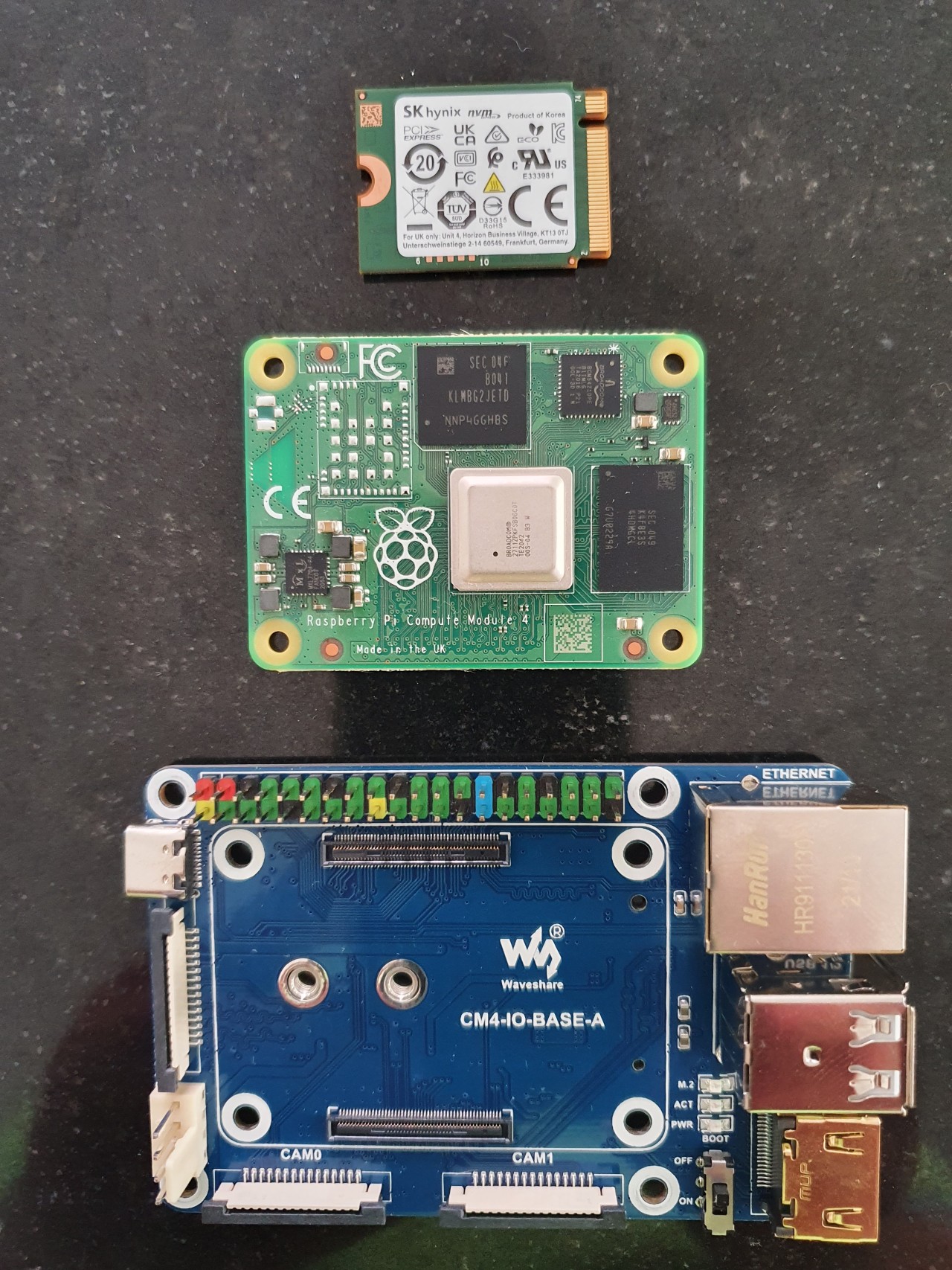
Hynix NVMe, CM4 and Waveshare Mini Base Board A (from top to bottom)
Parts assembled
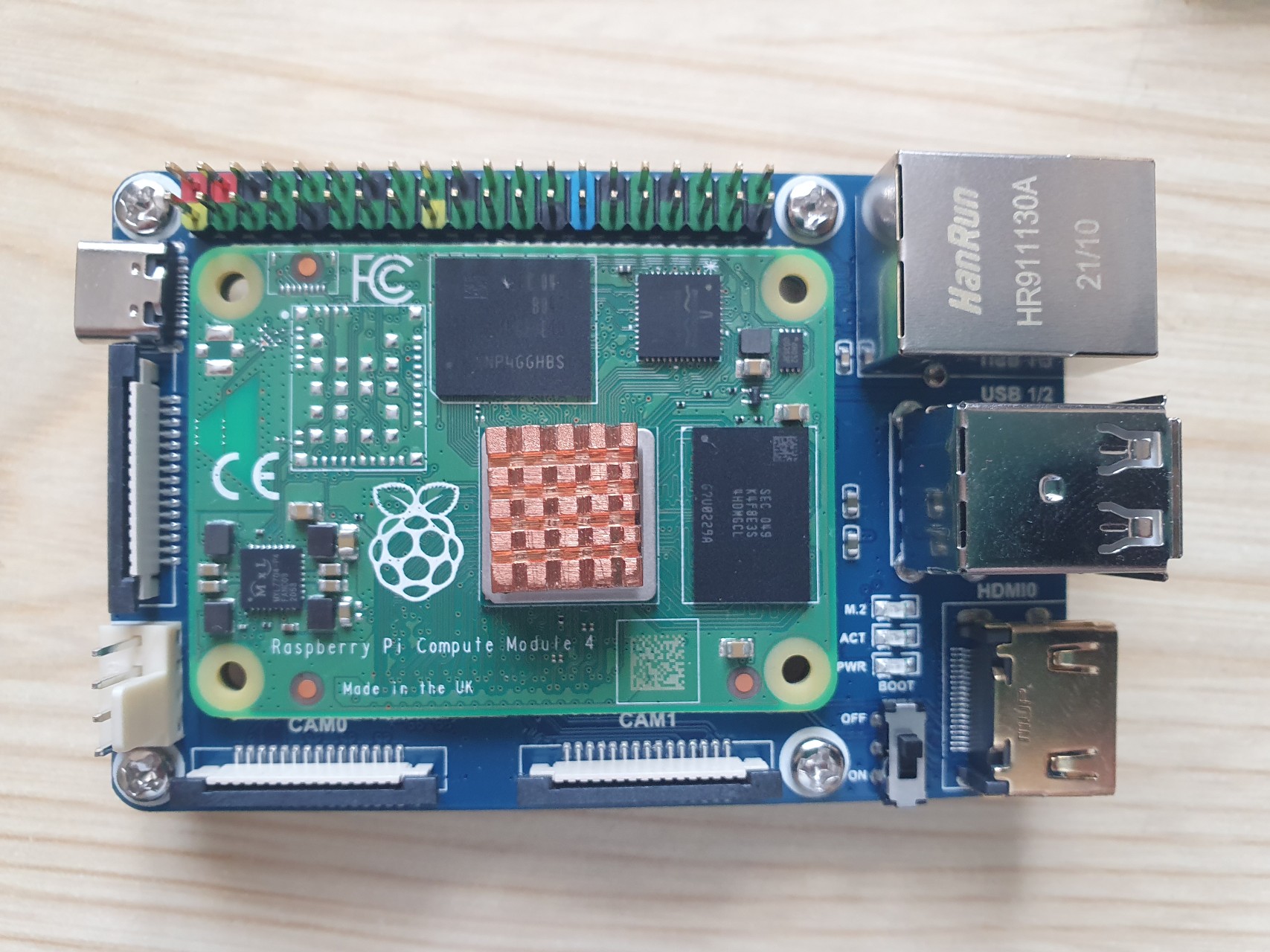
Read more: Raspberry Compute Module 4 (CM4) setup guide on eMMC and NVMe
- Details
- Category: Raspberry
- Hits: 378

I have an old Raspberry 1B which I want to use to evaluate OpenWrt. I bought two USB32ETH adapters because the RPi1B only has one ETH interface. On following pages I describe the steps I executed to boot the system headless in my home network.
- Details
- Category: Raspberry
- Hits: 1815
User Rating: 5 / 5
Recently I had to build a Linux kernel on my Raspberry Pi5 and detected the system became quite hot even with an original active cooler. That's the way I monitored the CPU usage and fan speed.
Read more: How to monitor CPU usage and cooling on a Raspberry
- Details
- Category: Raspberry
-
Also available:

- Hits: 38948
User Rating: 5 / 5
A lot of people are interested in a Raspberry Pi and want to get some idea about the operating system running on Pi without the need to buy a Pi first. I actually searched for a convenient way to test a backup script called raspiBackup I wrote for the Raspberry Pi. A nice way to evaluate Raspbian or to run any tests is to use QEMU to emulate the Raspberry Pi. Note that special Pi hardware like GPIO et al cannot be simulated. It's just the processor which is simulated. You need a Raspbian image and a system with Linux or Windows. Today I configured my system to run a Pi in QEMU and in the following article I explain step by step how I installed and configured QEMU on my Debian based Linux. The image has a networking connection right after startup and will use the existing host network connection with NAT. Finally a script is provided which executes the steps described and simplifies the image creation process.
- Details
- Category: Raspberry
-
Also available:
- Hits: 6395
Following page describes how to use a ZTE ML190 USB drive to receive SMS and forward them to another mobile phone number. But you can also send the SMS in an eMail or do other stuff. You can control any devices at home, i.e. turn on or turn off some device, open and close your garage and much more.
Update 5/2/2023
gammu requires Pyhon2 and will not be migrated to Python3. Therefore I now use smstools. Sample event handler smsevent includes a lot of sample code which only has to be adapted to the specific requirements.
Read more: Use ZTE ML190 USB pen drive to create a SMS relay server
- Details
- Category: Raspberry
-
Also available:
- Hits: 2638
btrfs has some nice features. That's why it makes sense to convert the root filesystem of a Raspberry running RaspbianOS from ext4 to btrfs.
Note: The following instructions require basic Linux knowledge because it's just a memory aid for me and the instructions are not very detailed.
Read more: Convert a rootfilesystem of a Raspberry from ext4 to btrfs
- Details
- Category: Raspberry
-
Also available:
- Hits: 3064
User Rating: 5 / 5
Unfortunately you need a USB A to USB A male cable which is very unusual. But there's a trick: Remove the lower part of the case which includes the SSD and pug in the USB bridge of the Argon case. Now you can use a commonly used USB extension cable to connect the SDD to your PC. Now use any common methods to install an OS on your SSD.
- Details
- Category: Raspberry
- Hits: 4724
Just call
curl https://download.argon40.com/argon1.sh | bash
If you run Ubuntu just call
cd /tmp/
wget https://raw.githubusercontent.com/meuter/argon-one-case-ubuntu-20.04/master/argon1.sh
chmod a+x argon1.sh
sudo ./argon1.sh
Read more: How to install ARGON ONE PI4 Power buttons & fan control
- Details
- Category: Raspberry
-
Also available:
- Hits: 21457
Owncloud has a very poor performance on Raspberry Pi. But seafile runs very fast if running on nginx. There exist already a lot of instructions how to install seafile on raspberry so you will find links to these website on the following page which I used to install seafile. In addition I wrote down the sequence of steps I executed. It's primaily a combination of the various installation instructions which I found. My config files of seafile running with nginx can be downloaded as sample config files for your convenience. In addition there is a startscript for /etc/init.d available which starts seafile all the time when Linux ist started and and stops it when it's shut down.
Characteristics of the seafileserver: foo.no-ip.org is used as external dns name, nginx (no apache), runs on secure https port and offers webdav services.
Read more: How to install seafile on Raspberry Pi ? (With config files)
- Details
- Category: Raspberry
-
Also available:
- Hits: 4605
User Rating: 5 / 5
Starting with Bookworm /boot/cmdline.txt was maoved to /boot/firmware/cmdline.txt. Therefore rpi-clone can unfortunately no longer update the UUID of the clone and the clone no longer starts. Details are described here on github.
Read more: rpi-clone doesn't create a bootable clone any more on Bookworm
- Details
- Category: Raspberry
- Hits: 15561
I backup my xbmc config on my raspberry pi with Linux and rsync.
On windows it's unfortunately not that easy. That's why I describe in the following paragraph how to create a backup on windows and how to restore a previous backup. In addition I provide two windows cmd files which execute the commands in sequence and make the backup and restore much easier. Three tools are requiered on windows: putty, pscp und plink which can be downloaded from the putty page. If you kick off the backup command with the at command on windows you will have an actual backup all the time.
- Details
- Category: Raspberry
-
Also available:
- Hits: 4432
PiShrink is a useful tool to compress backups created with win32diskimager and other windows tools as a full backup to reduce them to a minimum size.
It's a hack and works a lot of time. Unfortunatey there are a lot of situations you get an ugly error message which are created because of missing checks in the code.
- Details
- Category: Raspberry
-
Also available:
- Hits: 8147
User Rating: 5 / 5
We now have a new Raspberry4 gibt, which in contrast to the previous versions becomes quite hot. So everybody is interested in the effectiveness of either passive or active cooling and whether this cooling suppresses CPU throtteling.
I wrote a small script check_throttled.sh which reads the current throttling states of the Raspberry with vcgencmd get_throttled and if throtteling happens or already happend the meaning of the throttling bits is reported.
Subcategories
Page 1 of 6